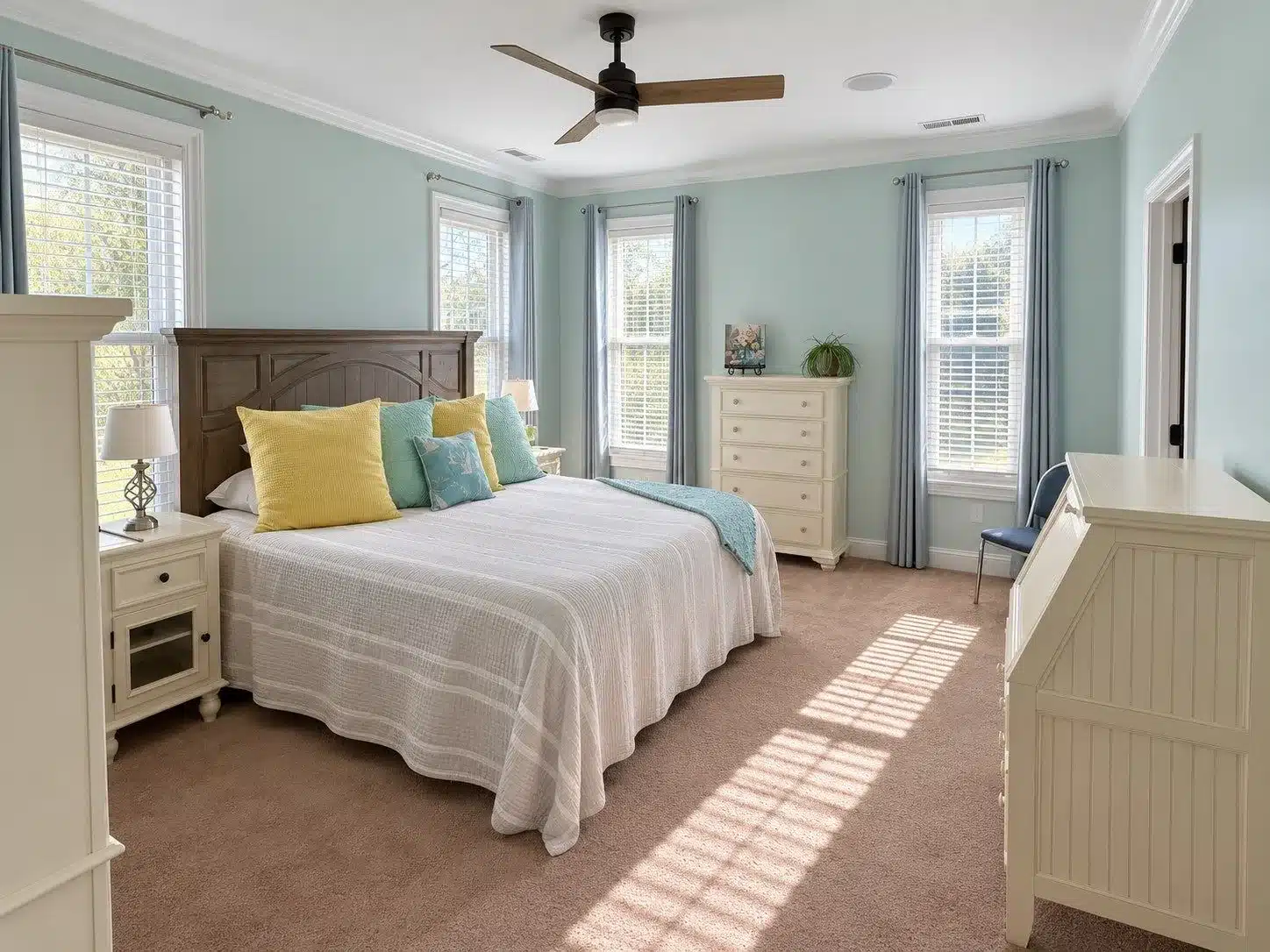
One coat of paint can look fine at noon and patchy by dinner. So how many coats of paint for interior walls does a room really need? The short answer on how many coats of paint a room takes is two coats in most cases. I’m Dustin Carroll, and I’ll show you when two is plenty, when a third makes sense, and what to ask before you hire a pro for interior house painting services in Surfside Beach, SC.
A straight number helps, but the right count depends on your walls, your old color, and your new one. Below you’ll find a quick table, a few facts from Sherwin-Williams, and a three step plan you can bring to your next estimate.

Why One Coat Rarely Tells the Whole Story
Say you want to repaint your living room. You pick a color and book a painter. Then you look at the estimate and wonder what it really covers. The outside problem is simple: paint applied too thin can leave streaks, dull spots, and shiny spots.
The inside problem is harder. Nobody wants to pay for a paint job twice, and one line on an estimate doesn’t always show how much work sits behind it. I also hold a simple belief. You deserve a straight answer about your own walls.
Here is how a coat works. Each coat lays down a thin film. On the Sherwin-Williams SuperPaint interior data sheet, that film is about 1.4 mils dry on the flat finish, and one gallon covers 350 to 400 square feet. A mil is one thousandth of an inch. Two coats double the film. The same sheet lists two coats of paint over drywall, with or without a primer coat first.
How Many Coats of Paint Does Your Room Need?
Here is a quick look at common cases. Treat it as a starting point, because a walk through your home will tell us more than any chart.
| Wall situation | Typical coats | What drives the count |
|---|---|---|
| Repaint in a similar color; walls in good shape | 2 coats | Builds an even film and an even sheen |
| New drywall or large patches | 1 coat of primer, then 2 coats of paint | Raw surfaces soak up paint unevenly |
| Deep or vivid new color | 2 to 3 coats | Strong pigments need more passes to look true |
| Dark old color to a light new color | Primer, then 2 coats, sometimes 3 | The old color can show through |
Sherwin-Williams lists two paths for drywall: two coats of paint that primes itself, or one coat of primer plus two coats of paint. Either way, the paint count stays at two.
When a Third Coat Makes Sense
Two coats is the standard, but it isn’t a rule for every wall. A third coat earns its place in a few cases:
A tinted primer can save a coat. Sherwin-Williams says about 20 percent of the colors in its palette reach their full color over a gray tinted base. A Cleveland painter quoted on that page said deep colors that once took three coats now take two.
I’d also push back on extra coats used to cover weak prep. A third coat is not a fix for a bad surface. Sanding, patching, and priming come first.
What About One Coat Paint?
Some cans say one coat or paint and primer in one. That can sound like a shortcut. Read the data sheet, not just the front label. Sherwin-Williams SuperPaint is sold as a paint and primer in one, yet its data sheet still lists two coats over drywall when the paint primes itself.
A label describes the paint. Your walls decide the count. So when an estimate says one coat, ask why. There may be a good answer, such as a close color match on sound walls. Ask to see it in writing.
Humidity, Drying Time, and Your Home in Surfside Beach, SC
Paint needs time between coats. Sherwin-Williams lists a 4 hour recoat time at 77°F and 50 percent humidity. The data sheet also says drying and recoat times depend on temperature, humidity, and film thickness. So a muggy day can stretch the wait.
If your home sits close to the coast, ask your painter how humidity changes the schedule. A good painter waits the full time your paint and your room call for, even when it slows the day down.
A Simple Plan for a Room That Looks Even
Here is the plan we use on our interior painting service jobs. It takes three steps:
Your itemized estimate shows what’s included. Nothing about the work stays a mystery, and that includes the number of coats.
What Too Few Coats Can Cost You
Here is what can happen when a room gets too few coats:
A repaint costs time and money twice. You move the furniture, tape the trim, and wait for paint to dry again. Getting the count right the first time keeps the bill honest.
Questions to Ask Before You Sign an Estimate
These five questions work with any painter. Clear answers tell you a lot about the job.
Line your quotes up side by side. The estimate that lists coats, primer, and prep is the one you can compare fairly. If one quote leaves those out, ask for them before you decide.
What a Well-Painted Room Looks Like
When the coats are right, the color looks the same from every angle. The sheen stays even from wall to wall. You stop thinking about the paint, and that is the goal. Asking how many coats of paint a room needs is a small question. It helps you pay for the right work once.